
Navigation


We list some cases of fastener corrosion problems that occurred in actual work, analyze the root causes of the problems, and explain the solutions to the problems. We hope to provide you with reference and ideas for solving the problems.
Analysis of causes of fastener corrosion、
First, a fishbone diagram is used to illustrate possible failure modes and causes of fastener corrosion:
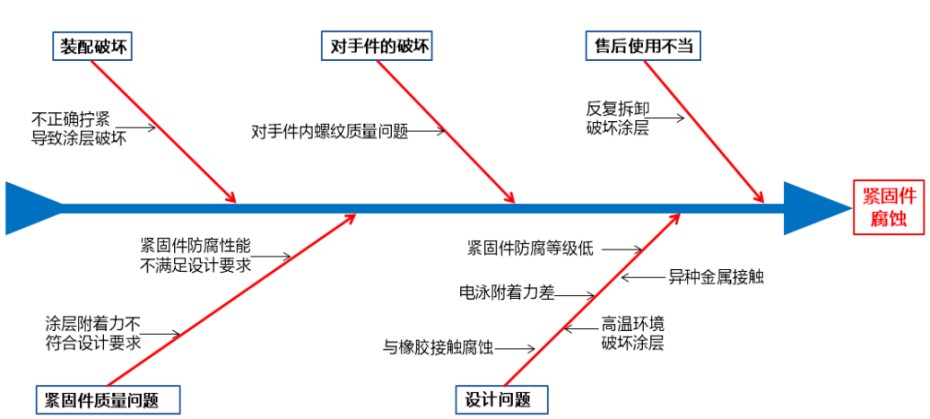
Corrosion due to coating damage caused by incorrect tightening
For example: the plum groove of the side sliding door limiter screw is rusty
Cause: Damage due to incorrect tightening
Change measures: standardize the tightening method and ensure that the torx screwdriver and groove shape are fully matched. In actual production on the production line, control the production rhythm and not be too fast. The operator must ensure that the torx screwdriver is completely close to the bottom of the inner torx screwdriver and strictly control the speed of the torx screwdriver. , cannot be too high, let alone change the rotation speed set by the process engineer at will, and strictly enforce process discipline.
Corrosion caused by quality problems of internal threads of counterpart parts
For example: The threads of the engine mount to subframe connecting bolts are rusty
Reason: The anti-slag coating of the welding nut interferes with the external thread, which changes the matching accuracy of the internal and external threads, causing surface damage to the external thread.
Change measures: Cancel the welding slag coating to avoid damage to the external thread, and use other methods to prevent welding slag.
Anti-corrosion performance of fasteners does not meet design requirements
For example: The subframe to body connecting bolt gasket is rusty
Reason: The area between the flange and the gasket is narrow, the shot blasting is incomplete, and the coating is difficult, resulting in low corrosion resistance there.
Measures: Reduce the shot blasting load, increase the shot blasting time, and improve the shot blasting effectiveness; reduce the centrifugal speed and increase the coating thickness.
Fastener grade is low
For example: the front hatch cover lock fixing bolts are rusty
Reason: The bolt salt spray test requires no red rust for 168 hours, and the anti-corrosion level is low.
Change measures: Improve the anti-corrosion level of bolts to 240h without red rust.
Corrosion caused by contact of dissimilar metals
For example: the brake cable fixing bracket bolts are corroded
Reason: The surface of the bolt is galvanized aluminum and the cable spring bracket is made of stainless steel. Due to the potential difference between the connecting materials, galvanic corrosion and rust occur on the surface of the bolt that is more likely to rust in the corrosive liquid.
Measures: Optimize the design and remove the spring brackets on the left and right parking cables to eliminate the conditions for galvanic corrosion.
Corrosion due to rubber contact
For example: the fixing nut of the air conditioning pipe is corroded
Reason: Rubber vulcanization contains residual sulfur elements, which form acidic substances in high temperature and high humidity environments, aggravating metal corrosion.
Measures: Rubber material is inevitable, improve the surface treatment method and anti-corrosion level of the nut, such as changing to zinc-nickel plating
High temperature environment coating damage and corrosion
For example: front catalytic converter fixing bolts are corroded
Reason: High temperature causes the galvanized layer to be damaged.
Measures: It is recommended to use zinc-aluminum coating when the temperature exceeds 100℃. When the temperature exceeds 200℃, the commonly used coatings cannot meet the requirements. You can seek rust-proof inspection exemption.
Chuangtuo Jinggong (Jiangsu) Co., LTD is profession manufacturer of various types of Hexagon Nuts, everything is customized in our factory, Should you have any questions please feel free to come back to us.
Contact: Lorena
Email: market@chtofastener.com
Mobile: 0086 153 6641 6606 (Wechat/Whatsapp ID)